
Level 2 Certificate in Counselling Skills
This training is designed to give learners the underpinning knowledge, skills, and competence to use counselling skills ethically and safely in a variety of contexts and roles.



This training is designed to give learners the underpinning knowledge, skills, and competence to use counselling skills ethically and safely in a variety of contexts and roles.
Level 3 Qualification is designed for candidates who have undertaken counselling skills training, e.g. our Level 2 Certificate in Counselling Skills or equivalent.
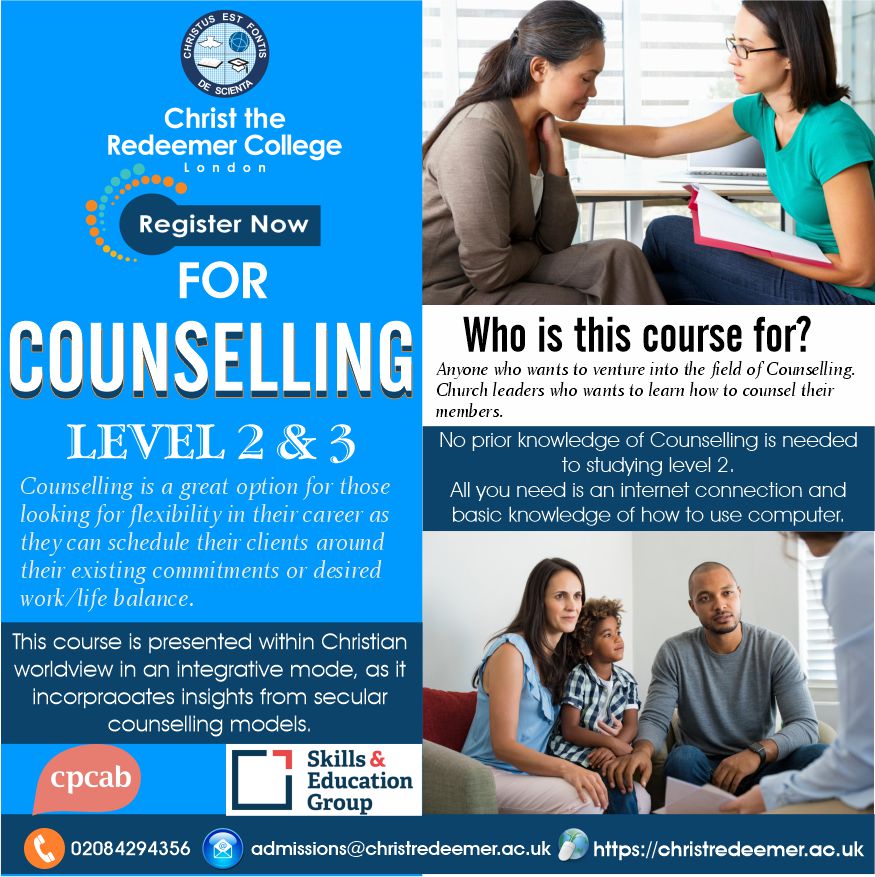
This course consists of a minimum of 90 guided learning hours and looks at how we can listen to and understand others better and help them to work towards their goals in life. There are thirty sessions each of three hours that may be offered in a number of formats, for example three sessions on a long Saturday once a month for ten months or twice a month for five months, or one evening a week for thirty weeks. How we offer the course will vary from centre to centre.
This course consists of a minimum of 90 guided learning hours and looks at how we can listen to and understand others better and help them to work towards their goals in life. There are thirty sessions each of three hours that may be offered in a number of formats, for example three sessions on a long Saturday once a month for ten months or twice a month for five months, or one evening a week for thirty weeks. How the course is offered will vary from centre to centre.
Introduction to Counselling Skills Training held over six consecutive days from Monday 3 August to Saturday 8 August inclusive 10.00 – 17.00 at the University of Northampton Innovation Centre.
This course is for those who are looking to become proficient in the practice of reflective pastoral supervision both as supervisor and supervisee. The qualification may of interest to you if:
The Level 4 Diploma in Therapeutic Counselling is a nationally regulated qualification awarded by the Counselling and Psychotherapy Awarding Body (CPCAB).

Applicants for Step by Step training are required to have completed some basic counselling skills training (e.g., image’s 60-hour course in Christian Pregnancy Counselling skills or the equivalent), to have had some experience in pastoral care and to provide a reference from a church or pregnancy centre leader.

For those already practising, gain a Level 6 degree in 1–2 years with direct ACC accreditation (SCoPEd Column B) as a graduate outcome.
For those with a degree, become a professionally qualified counsellor in 3 years through this part-time, Level 7 Master’s programme.
Gain professional accreditation with EMCC, integrate faith and spirituality in your practice and develop your coaching and mentoring skills. Explore a theological framework and safe working practices for integrative coaching and mentoring. Learn alongside others, with the support of a personal coach practice mentor and with experienced tutors. The course starts in September 2026 and runs through to July 2027.